The following game is a classic example of Combinatorial Game Theory:
Two players start with a strip of $n$ white squares and they take alternate turns.
On each turn, a player picks two contiguous white squares and paints them black.
The first player who cannot make a move loses.
- $n = 1$: No valid moves, so the first player loses automatically.
- $n = 2$: Only one valid move, after which the second player loses.
- $n = 3$: Two valid moves, but both leave a situation where the second player loses.
- $n = 4$: Three valid moves for the first player, who is able to win the game by painting the two middle squares.
- $n = 5$: Four valid moves for the first player (shown below in red), but no matter what the player does, the second player (blue) wins.
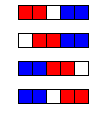
So, for $1 \le n \le 5$, there are 3 values of $n$ for which the first player can force a win.
Similarly, for $1 \le n \le 50$, there are 40 values of $n$ for which the first player can force a win.
For $1 \le n \le 1 000 000$, how many values of $n$ are there for which the first player can force a win?
Solution
No solution yet. Write yours at
solutions/s306.md.